

 | ||
|
| ||
News |


|
| Custom Webbing & Strap Assemblies: 6 RFQ Essentials for OEM Buyers | |
2026-11-23 14:25:52 | |
Custom Webbing and Strap Assemblies: 6 RFQ Details for OEM Buyers
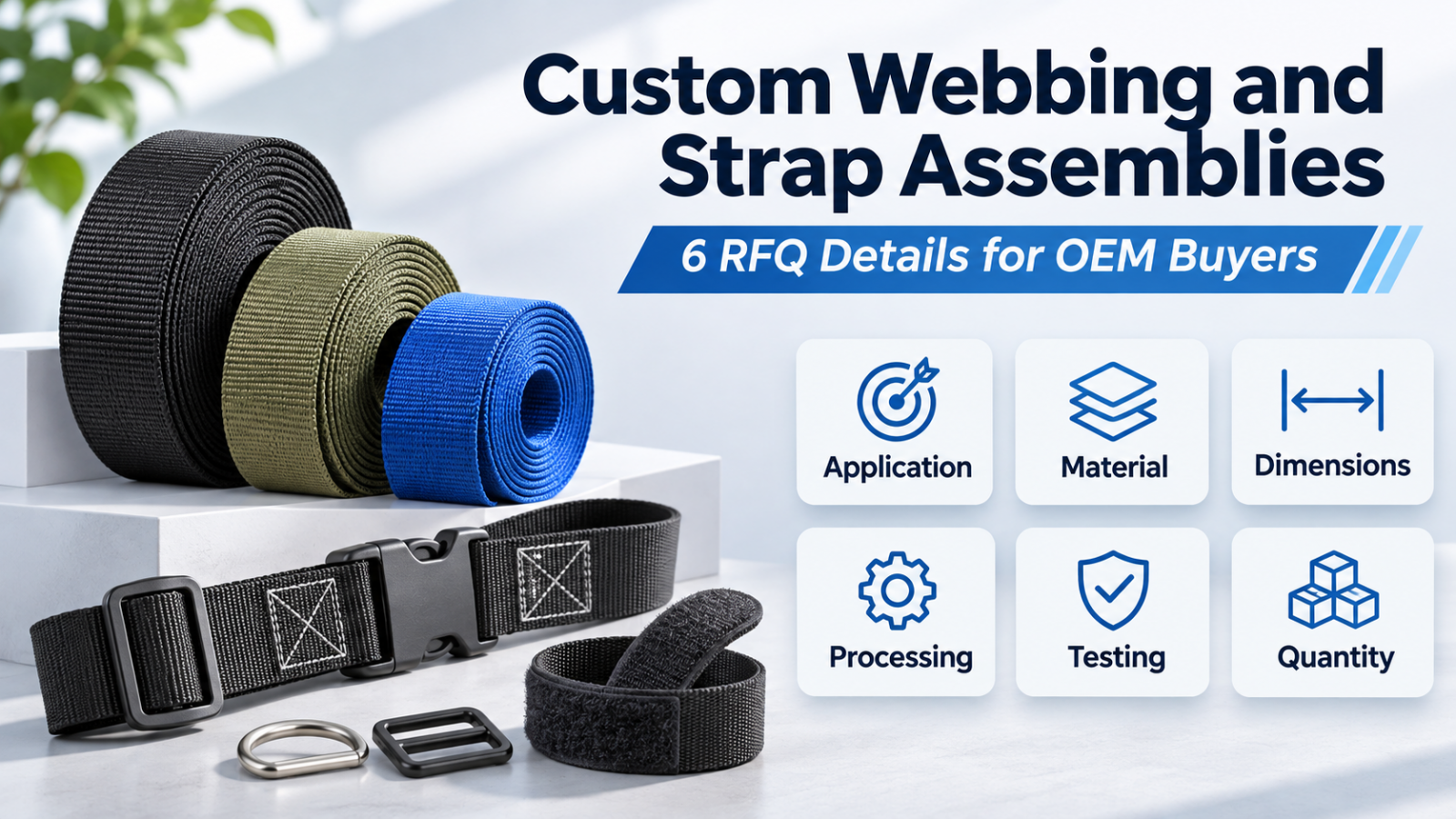
Trade shows introduce new materials, applications and sourcing opportunities, but purchasing decisions often begin after the events. With MEDICA 2026 and IATF Dubai 2026 recently concluded, many OEM development projects may be moving from product research to supplier evaluation.
For custom webbing and strap assemblies, a clear request for quotation (RFQ) helps manufacturers review production feasibility, prepare samples and provide more accurate quotations.
Here are six important details buyers should confirm before starting a custom textile component project.
1. Define the Product Application
The first step is explaining how the webbing or strap will be used.
A strap for a medical support product may need flexibility, comfort and repeated adjustment. A luggage strap may require different strength, abrasion resistance and fastening characteristics. Industrial applications may involve additional environmental or performance requirements.
Providing the intended application helps manufacturers recommend appropriate materials, constructions and processing methods rather than quoting a product based on appearance alone.
2. Select the Material and Construction
Polyester, nylon, polypropylene (PP) and other materials offer different characteristics for textile accessory applications
Buyers should consider the required strength, flexibility, surface texture, moisture exposure and expected service conditions.
The construction also matters. Woven webbing, knitted tape, braided tape and elastic materials serve different functions.
When the material has not been finalized, sharing an existing sample or describing the required performance can help the supplier evaluate suitable alternatives.
3. Confirm Dimensions and Tolerances
Width and length are essential, but they are not the only dimensions that matter.
Thickness, stretch requirements, finished length, cutting tolerance and end treatment may affect how a component fits during assembly.
For example, a strap supplied on rolls may have different manufacturing requirements from a finished strap with sewn loops, attached hardware or hook-and-loop fasteners.
Buyers should clearly distinguish between raw material dimensions and the required dimensions of the completed component.
4. Identify Processing and Assembly Requirements
Many OEM projects require more than standard webbing production.
Additional processing may include custom dyeing, logo printing, jacquard weaving, cutting, sewing, silicone grip application, hook-and-loop attachment or hardware assembly.
Selecting these processes during the development stage helps manufacturers review material compatibility and production requirements.
Fu Jyi Lin Enterprise Co., Ltd. (Fujyilin) supports integrated textile accessory manufacturing and custom processing, allowing customers to discuss both material selection and finished component requirements within the same development project.
5. Clarify Performance and Testing Expectations
Performance requirements should be discussed before sample development.
Depending on the application, buyers may need to evaluate tensile strength, abrasion resistance, colorfastness, washing durability, fastening performance or other characteristics.
For load-bearing applications, it is important to distinguish breaking load from working load and confirm the required testing conditions.
For specialized uses, such as protective equipment or medical-related products, applicable performance standards and documentation requirements should be identified separately.
Final performance claims should always be supported by the relevant product specifications and test results.
6. Provide Quantity, Packaging and Project Details
A complete RFQ should include estimated order quantity, expected annual demand, color requirements, packaging preferences and desired delivery schedule.
These details help suppliers evaluate material sourcing, minimum order quantities, sampling requirements and production planning.
Technical drawings, reference samples, photos and existing product specifications can also reduce unnecessary revisions during development.
Buyers who are still reviewing the design can begin with the main product requirements and identify the details that require further confirmation.
Custom Manufacturing Support from Fujyilin
Fujyilin supplies custom webbing, textile tapes, hook-and-loop fasteners and related textile accessories for international OEM and ODM projects.
Our services cover material selection, product customization, processing, sampling and finished strap assembly.
Explore our [Webbing & Tape products](https://www.fjltextiles.com/sub_productadd_en.php?id1=5) or learn more about [FJL Manufacturing services](https://www.fjltextiles.com/sub_productadd_en.php?id1=40).
For a project review or quotation, please send your application, dimensions, materials, estimated quantity and available drawings or samples to **info@fujyilin.com.tw**.
We welcome discussions on new product development and customized manufacturing requirements.
|
 |
Fu Jyi Lin Enterprise Co., Ltd. Copyright © 2014 |
| Address: 10071 No.17-1, SHAU ANN St., Zhongzheng Dist., Taipei City 100, Taiwan (R.O.C.)
TEL:886-2-2301-5900 , 886-2-2307-0952 FAX:886-2-2307-5424 , 886-2-2332-6930 E-Mail:info@fujyilin.com.tw |