

 | ||
|
| ||
News |


|
| Introduction to Jacquard Ribbon & Jacquard Webbing Differences and Custom Applications | |
2026-05-28 12:00:38 | |
What Is the Difference Between Jacquard Ribbon and Jacquard Webbing? Introduction to Custom Webbing Applications and Processing
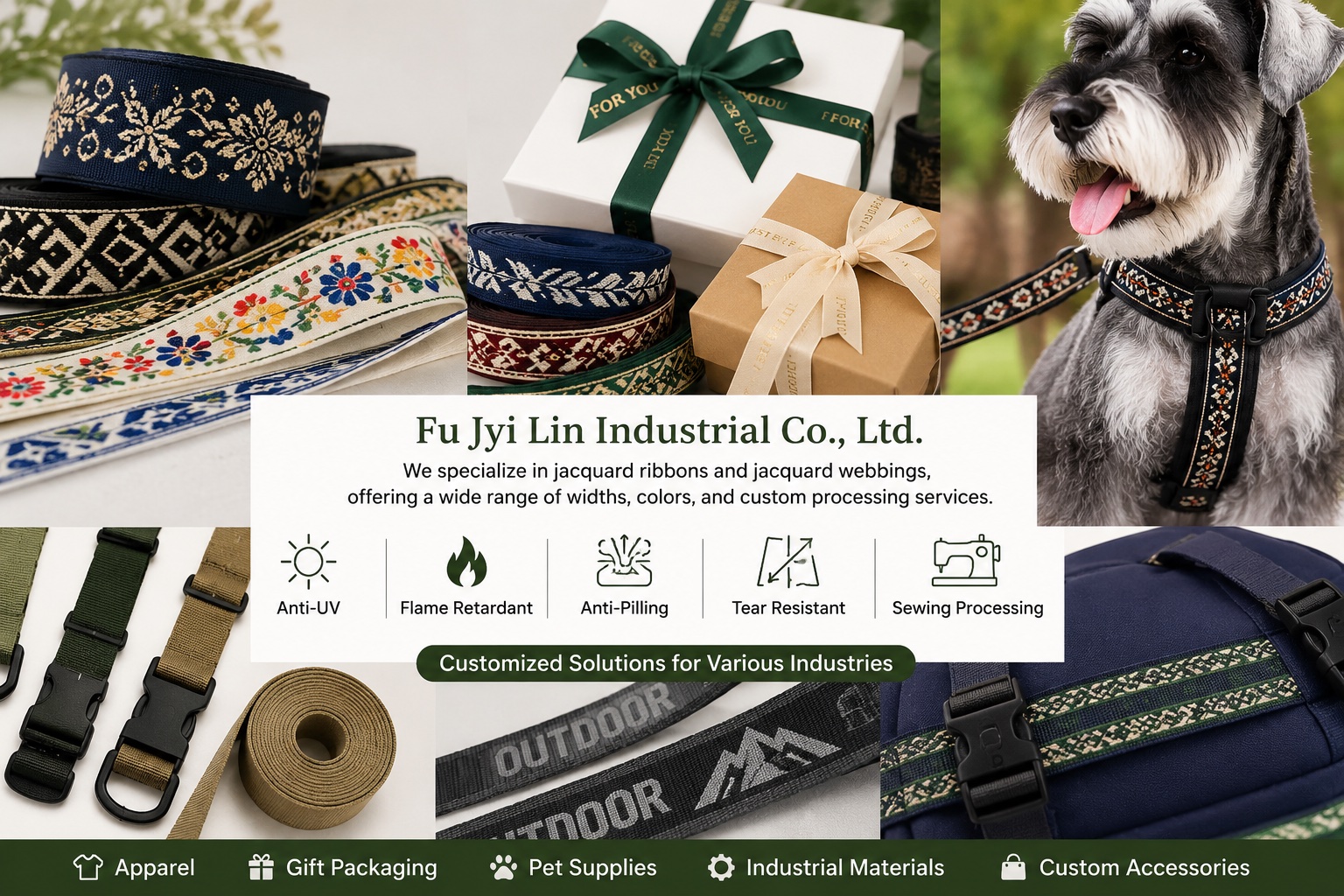
Jacquard ribbons and jacquard webbings are both woven textile accessories, but they differ significantly in materials, structure, functionality, and product applications. With increasing market demand from apparel, packaging, pet products, outdoor gear, and industrial applications, customized jacquard products have become widely used across various industries.
Fu Jyi Lin Industrial Co., Ltd. is a professional ribbon and webbing manufacturer in Taiwan, specializing in custom jacquard ribbons and jacquard webbings. We provide customized weaving, dyeing, finishing, and sewing services based on different product requirements.
Difference Between Jacquard Ribbon and Jacquard Webbing
Jacquard Ribbon
Jacquard ribbons are generally softer with a finer surface texture and are commonly used for:
• Gift packaging
• Garment decoration
• Hair accessories and handicrafts
• Festival and luxury packaging
• Ribbon embroidery and DIY applications
Their main feature is the delicate woven pattern and decorative appearance, which can enhance product aesthetics through various color and texture combinations.
Jacquard Webbing
Jacquard webbings focus more on durability and functionality and are widely used in:
• Backpacks and bags
• Pet leashes and harnesses
• Industrial safety products
• Outdoor equipment
• Garment accessories and belts
• Sporting goods
Jacquard webbings are designed for higher strength and durability, with adjustable thickness, weaving structures, and material options depending on the application.
Custom Jacquard Ribbon & Webbing Services
Fu Jyi Lin Industrial Co., Ltd. offers:
• Multiple width specifications
• Custom logo and pattern weaving
• Various material combinations
• Custom dyeing services
• Functional finishing treatments
Due to dyeing production requirements, each color has a minimum order quantity limitation. Actual MOQ may vary depending on product specifications and color requirements.
Special Functional Finishing Services
In addition to standard weaving production, we also provide various functional finishing treatments, including:
• Anti-UV treatment
• Flame retardant finishing
• Anti-pilling treatment
• Tear-resistant enhancement
• Water-repellent coating
• Sewing and assembly processing
These webbings and ribbons can be further developed into:
• Pet products
• Bag accessories
• Garment trims
• Industrial products
• Outdoor equipment
• Customized webbing products
Professional Jacquard Ribbon & Webbing Manufacturer in Taiwan
Fu Jyi Lin Industrial Co., Ltd. has years of experience in ribbon and textile accessory manufacturing and is committed to providing stable quality and customized solutions. We support global customers in developing jacquard ribbons and jacquard webbings that meet various market requirements while offering flexible production and processing services for different industries.
Ribbon Embroidery Introduction
Modern ribbon embroidery is quite different from the ribbon embroidery traditionally used on aristocratic garments during the 18th and 19th centuries.
Today, a wide variety of ribbons are specially designed for embroidery purposes. These ribbons come in different materials, textures, and widths, allowing users to select stitching techniques that best match the ribbon characteristics. As a result, ribbon embroidery has evolved into a more diverse and creative art form in modern applications.
Even when using the same stitching method, the appearance of ribbon flowers may vary depending on the ribbon texture, stitch length, ribbon tension, and sewing direction. These subtle differences create unique visual expressions on fabric surfaces.
The relationship between the needle and ribbon can be compared to perfect partners working together on fabric. Through these two elements, ribbon embroidery can develop into five major styles:
• Flat embroidery
• Loop and chain combinations
• Knotted decorative patterns
• Floating three-dimensional effects
• Unique layered ribbon textures
The size of the needle, ribbon characteristics, stitching direction, and needle placement all contribute to creating different visual effects on simple fabric surfaces.
Basic materials required for ribbon embroidery include:
• Embroidery ribbons
• Embroidery threads
• Plain fabric
• Embroidery needles
• Chenille needles
• Tracing paper
• Stylus pen
• Correction pen
• Scissors
The design is first transferred onto the fabric using tracing paper. The ribbon is then threaded through the embroidery needle, tied with a small knot, and stitching techniques are practiced from outside to inside or vice versa.
Five Basic Ribbon Embroidery Techniques
1. Flat Embroidery
The most basic embroidery technique. Whether stitching vertically, horizontally, diagonally, from top to bottom, or bottom to top, the second stitch is based on the original stitch position.
Common examples include:
• Three-petal flowers
• Heart shapes
• Circular patterns
• Grass shapes
• Herringbone designs
• Curved lines
• Cross-square patterns
2. Loop and Chain Combination
This technique is also based on flat embroidery. After the first stitch, the original ribbon is held with fingers while the second stitch passes through, creating different curved shapes from either the left or right side.
Examples include:
• Y-shapes
• V-shapes
• Pinecone patterns
• Coral designs
• Seaweed patterns
• Circular loops
3. Knotted Decorative Patterns
This combines flat and symmetrical embroidery techniques. By leaving slight spacing and using multiple knotting methods, a sense of depth and dimensionality can be created on the fabric.
Common stitches include:
• Single knots
• Double knots
• Rose petals
• V-shaped knots
4. Floating Three-Dimensional Effects
After mastering the basic techniques, advanced dimensional embroidery can be created using twisting methods and multiple knots to achieve a three-dimensional appearance.
Popular styles include:
• Multi-petal roses
• Interlaced extensions
• Inward and outward twisting effects
These techniques create decorative embroidery suitable for home décor and artistic textile applications.
5. Unique Ribbon Layering Effects
By combining ribbons of different colors, embroidery designs become even more vivid and lifelike.
In this technique, embroidery threads are rarely visible, as most are hidden beneath ribbon folds and overlapping layers.
Advanced embroidery styles include:
• Branch bouquets
• Circular wreaths
• Hydrangea flowers
• Scale-style embroidery
• Peony flower embroidery
These are considered expert-level ribbon embroidery techniques for advanced embroidery enthusiasts.
|
 |
Fu Jyi Lin Enterprise Co., Ltd. Copyright © 2014 |
| Address: 10071 No.17-1, SHAU ANN St., Zhongzheng Dist., Taipei City 100, Taiwan (R.O.C.)
TEL:886-2-2301-5900 , 886-2-2307-0952 FAX:886-2-2307-5424 , 886-2-2332-6930 E-Mail:info@fujyilin.com.tw |